Resources

Showing posts with label leadership. Show all posts

17/10/2014

An Educator's Role in Protecting Students Online


Statistics of Home Internet Safety Highly Concerning
Click for image source

As the year unfolded this year, my teaching partner, my teaching partner and I were committed to getting our class blogs up and running for our respective classes. As we discussed what this would look like on a computer screen and in the classroom; we knew that we would need to consider our students needs. The things we considered were how to keep students safe, did we want the public to access and share on our blogs, and how do we ensure the students are acting appropriately online. As we continued our discussions, colleagues began to inquire about our methods. We found that not only were we working at ensuring student safety, we were also in dialogue and sharing ideas with our peers.
 
According to OCT Standards of Practice, teachers should promote and participate in the creation of collaborative, safe and supportive learning communities (OCT Standards of Practice). At times, participation in learning groups happens in formal settings and other times it happens informally. The two of us have been involved more with informal learning. As I have stated, we often discuss the learning that is occurring in class and where we are heading with the students. I had one colleague ask one day, “What do you two talk about each night?” One of the things that I shared with her was how we were working on getting our blog started. This sparked an interest in her as she had attended a tech night, put on by our board that dealt with classroom blogging. Suddenly, our informal group of two grew to include another member and we had begun to create our own personal learning network. It has since grown further with a few other staff members who are venturing into blogging and other 21st Century learning experiences with their students.

Within our PLN, our main focus was how to manage the blogs with our different grade levels. We wanted to expose students to the world of blogging while keeping them safe. According to the ethical standard of Care, teachers are committed to students’ well-being and learning through positive influences, professional judgement and empathy (The Ethical Standards for the Teaching Profession). It is with the Ethical Standards in mind, that we began to share some of the knowledge we had gained in our Integration of Technology Course Part 2. We began to share lessons we had created with our colleagues and we continued to discuss the importance of ensuring the safety of students. Using our professional knowledge, we decided that with our primary grades, we would create a blog that would be worked on as a class in a type of shared writing opportunity. We would focus mostly on sharing our information and comments within our immediate community of students and parents. Our juniors would start blogging as a shared experience as well, with the goal of eventually interacting with our blog independently from home and by interacting with other blogs globally. This decision was based on our knowledge of students’ ability and their access to technology. With in class support and modelling, we felt that this was the best way to ensure the safety of our students. The next step would be putting our theories and planning into practice. 
 
Within our PLN we have had many discussions about how students today are part of the ‘digital generation.’ Most of them are online on a regular basis (whether their parents like it or not). This year when surveying our students, we learned that most of them are online at least once a week and many of them are online daily. We feel that not only does this show us that using online tools is a motivating factor for our students, but that it is also becoming more and more important to have conversations in the classroom about online safety and digital responsibility. As well, a quick conversation is not enough to instill good habits into our students. Rather, frequent modelling and practice of these skills is what will help ensure safe and responsible use for our students.
With doing so much activity online at school, we have developed lessons to start the year off to introduce safe online activity. In addition, we have continued to revisit these concepts with our students each time we get online or use our class blog. Our students have now become ‘experts’ at pointing out when someone else in the online community has done something poorly to impact their digital footprint or when someone else has provided information that may not be keeping them safe.
Without us intending on doing so, this has become great sharing and modelling within our PLN. Our colleagues see how our students now naturally think about their actions online. They see how much students online activity increases through the primary grades into the junior grades and they have come to recognize that early discussions about safety and online etiquette help to shape responsible digital citizens. While our lessons and ways of teaching are newly developed and will need tweaking in the future; they have provided some of our colleagues with a jumping off point or with an idea of how to create their own lessons on internet safety and digital responsibility. Our informal discussions within the PLN have encouraged others to agree with our views that tackling these issues in the classroom is important and valuable. Hopefully this suggests that we ourselves are becoming good leaders with respect to our online actions.

In the spirit of sharing, here are some of the things we have done to help ensure the safety of our students online, as well as some of the lessons we’ve used to encourage them to be good digital citizens. It is our hope that these actions are ensuring the safety of our students.

Discuss the value of blogging with students and parents - WHY BLOG

Create blogging guidelines for our students to follow and send this home with a letter letting parents know what will be involved in our online activity at school

Teach lessons on what information should not be shared online - STUDENT SAFETY ONLINE

Teach lessons on creating Quality Comments so that students are safe and so that they are kind to others online

Teach lessons on how to copy work properly, so as to respect other online users and the original authors of online work - COPY THE RIGHT WAY

25/09/2014

Creative Commons

I have commented on Creative Commons in an early post.  Here is a guest post from my teacher partner with some more insight.

The Creative Commons was developed as a complement to copyright licenses.  It offers authors of published online works (i.e. blog posts, photos, podcasts, video, etc.) to freely share their work with others while protecting their work from being used or changed in a manner they don't wish to have happen.

Leaders in the education field (or any field for that matter) need to respect the Creative Commons attributions or fair use statements provided b the author of the online works they are using.  When students create work in the classroom, we teach that that work is their alone and they have earned the right to receive recognition for their hard work.  As leaders in education, we should support the idea that someone who creates a piece of work deserves credit for that work.  We also need to respect that the person may not wish to have their work altered or shared.  By modelling fair use of content, leaders encourage others in their organization to do the same and this in turn, those people will hopefully follow the same logic.  It will filter down and as teachers in our system ensure they are respecting fair use statements and Creative Commons attributions; students will learn to do the same.  They will also learn that if one day they share a piece of work they too can be respected for their hard work.

In light of Ray's last post regarding our staff survey on fair use and the Creative Commons, it is clear that this is still unfamiliar to many and would thus be difficult to expect teachers to models fair use with their students. If we want our students to learn how to use material that has permission to be freely shared and how to give attribution where needed, our teachers need to learn how to do this so that they can lead by example.  Therefore, it is important that our leaders take the time to educate the teachers or people in their group about fair use.  Her a few things leaders can do to support their knowledge and understanding:

1.  Have discussions about what fair use is.

2.  Help the group learn about what the Creative Commons is all about.

3.  Post information explaining the four licensing options available through the Creative Commons.

4.  Show staff how to search for information that is free to use.

5.  Model how to respect fair use statements and Creative Commons by doing so in your own blogs and other places they use information found online.

Does you leader or staff know about fair use and the Creative Commons?  How can you help support them in educating their team on the issue?

For more on Creative Commons please visit:

http://creativecommons.org/

https://whiterabbitisme.wordpress.com/2012/01/19/the-abcs-of-creative-commons/

The Essence of 21st Century Learning and Leadership - Getting Connected

The essence of 21st Century Learning and Leadership comes down to the idea of becoming connected and one way of doing this is by developing a Personal Learning Network.  Personal Learning Networks or PLNS allow individuals to connect with others to share, communicate and request.  By creating a PLN, an individual creates relationships with others who have similar interests or needs.  This relationship leads to the sharing of ideas and resources, collaboration and new learning.  Over time, the PLN grows, connecting the individual to the global community Individuals interact in a variety of ways by using social networks and other online platforms.  Networking allows individuals to connect with leaders in education who can support the individual in their own self directed professional development.

When an individual self directs their professional development it leads to greater exploration or inquiry based learning.  In the past, teachers have had little input as to what PD would best fit their needs.  With a self directed inquiry process in mind, a teacher can create a PLN and seek out leaders for support and guidance.  An example of this is being done within our own school.  Our administrator has asked for our input as to what direction each individual feels they need to develop.  As a result of the needs of the individual teachers, our administrator has created five learning teams.  In a traditional setting, our administrator would need to facilitate five groups and bring in a variety of experts to meet each groups needs.  However, with social networking (i.e. twitter) our administrator could invite a number of experts to attend discussions or chats.  These experts would share their knowledge and provide prompts for the group to have dialogues that would lead to a deeper understanding. As the group of learners continue to dialogue and share information the expert or leader takes on the role of co-learner as all members are contributing to the learning.  As the conversation grows in the network, new experts are drawn into the network leading to greater collaboration.  With a wealth of input, a sharing of resources and rich conversation, the original learning group will become leaders.  These new leaders will be encouraged by their peers and leaders to join other PLNs in order to share their knowledge and expertise.

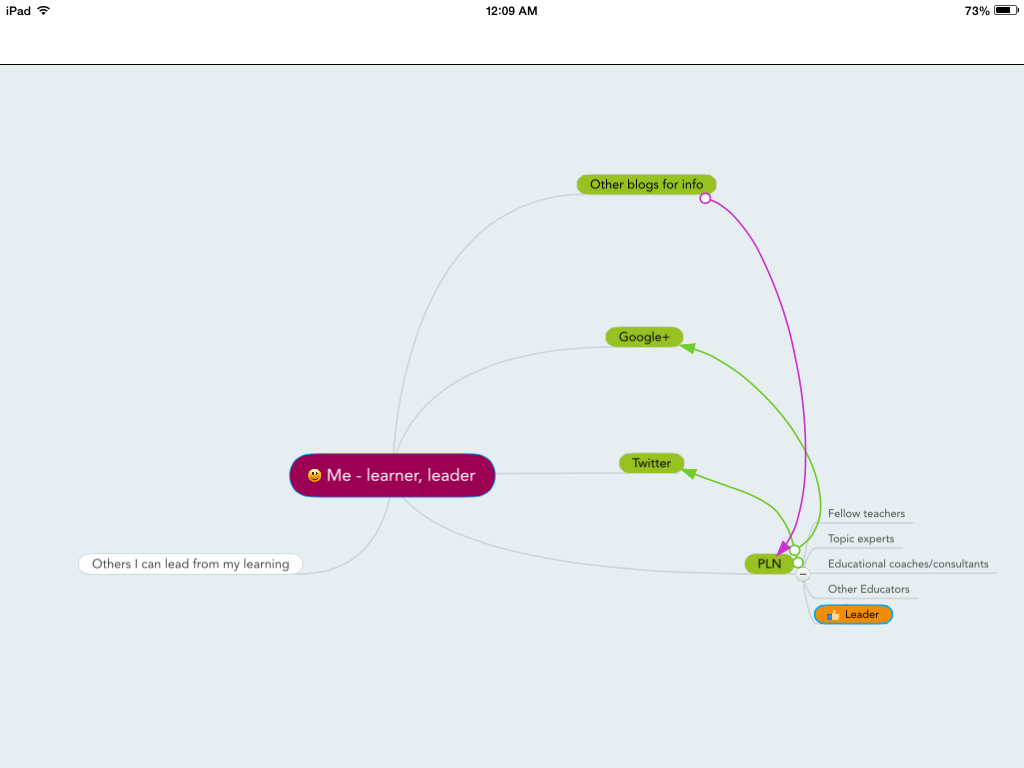
Here is an example of our personal learning network.  As we continue to develop and grow in different areas our links with others will continue to grow. In some instances we will be leaders and in other instances we will be the learner.

photo.PNG

Below are a number of links that describe Personal Learning Networks and tips on how to create and develop you own network:

http://teacherchallenge.edublogs.org/creating-a-pln/
http://gettingsmart.com/2012/01/personal-learning-networks-for-educators-10-tips/
http://educationaltechnologyguy.blogspot.ca/p/create-personal-learning-network.html

Chantelle and I were wondering if you have considered your personal learning network?  Who are the people you connect with and how do you access them when you have questions?
 

Social Networking and Leadership

Here is a guest post from my teaching partner, Chantelle Davies about the use of twitter to encourage learning within the school.  Many people are already using twitter in their personal lives so using twitter for professional discussions would be an easy what to get collaboration going in schools

click picture for source
Click for picture source

There are many ways to be a leader in a school.  You may be a principal, a consultant, a team or division leader, or simply (like me...hopefully) a leader in helping your staff to learn something new or work through a problem together.  Regardless of the extent of your leadership role, twitter is a tool that can be a great resource for staying connected with your staff.  In the school system, we often work in isolation and it is challenging to collaborate or plan times where everyone can come together.  With traditional methods, leaders must find a way to pull everyone together.  Using twitter keeps the doors of communication open 24/7. It encourages staff to all be contributors to the conversation and provides you (the leader) with a way sharing ideas in a format that does not require a boring staff meeting when everyone just wants to go home.  In addition, traditionally the leader does most of the sharing and the other participants listen an ask questions when prompted.  I have included a link here by Elana Lioni from Edutopia on 8 Tips to Create a Twitter-Driven School Culture.  I love number seven: Conduct a Twitter Chat.  What a great way to find out what staff want to know more about; and in addition, encourage them to learn from each other.  With twitter chat, leaders can ask prompting questions that allow all members to reflect and share their knowledge.  It also allows the opportunity to bring other experts into your conversation without requiring them to drive into your meeting as would be required in a traditional sharing setting.

Would the leader in your school be willing to consider using twitter to start a conversation at your school?  How might you help encourage staff members to support this new and innovative initiative?